

Every September, crowds fill the hill town of Yatsuo for three nights. Talk to the people who live there, though, and you learn that Owara is not only those three nights. Here is the festival as it is told locally, one step beyond the travel guide.
What the name means
The two hundred and tenth day after the start of spring falls around the first of September — the season of typhoons, when a single storm could decide the rice harvest. Owara is said to have its roots in a rite to calm those winds and pray for a good crop.
Bon, in the Toyama dialect, means a day off. The whole town stops work and gives three days to song and dance; the name says as much about the festival as any description could.
The eve dances of late August
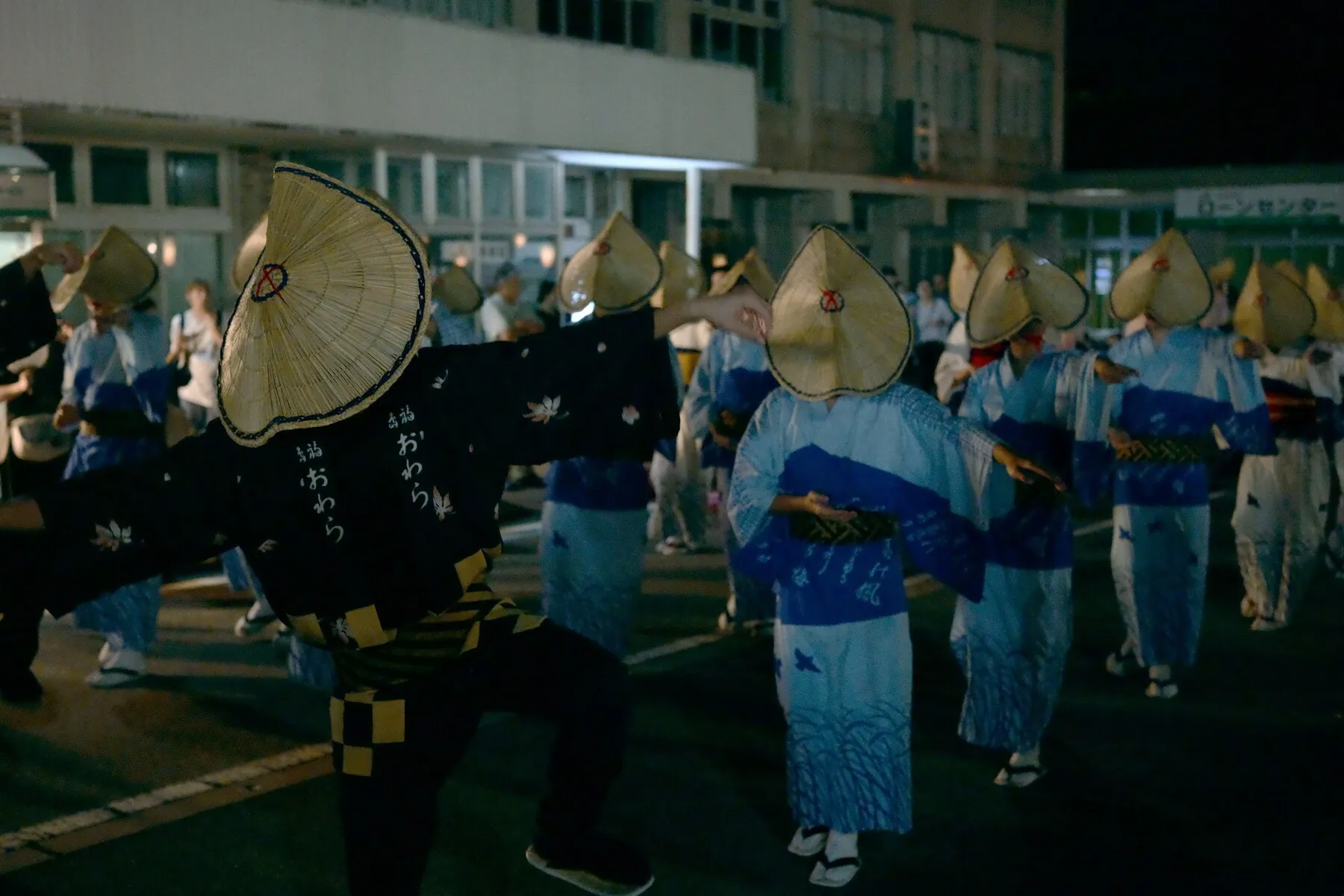
Before the main festival, the town has held eve dances (zenyasai) in late August. The neighbourhoods take turns, one each night, dancing machi-nagashi processions and circle dances through their own streets for a couple of hours in the evening. Crowds are far smaller than in September, and you can follow a single neighbourhood’s dancing at your own pace.
Visitors may join the circle dances; when you do, follow the directions of the neighbourhood’s organisers. During this period the Etchu Yatsuo Kanko Kaikan (the hall where the town’s festival floats are kept) has also hosted short dance lessons and stage performances. Dates change, and some years the eve dances are cancelled, so check with the Etchu Yatsuo tourist association before you plan around them.
The day the kokyu arrived
The kokyu — the bowed fiddle whose sound now defines Owara — was not part of it from the start. As the story is told, at the end of the Meiji era (around 1907–1912) Matsumoto Kangen, a travelling craftsman of Wajima lacquer, learned of the instrument from Sato Chiyo, a blind itinerant musician from Echigo, and brought it into Owara. In little more than a century, its plaintive voice has become the sound of the festival itself.
Between verses, another voice adds short, high calls — the hayashi. When the song ends, the instruments play an interlude on their own, the ai-no-te, with a melody quite unlike the song. Listen closely and you begin to hear how each neighbourhood plays it differently.
How locals watch
When the dancers pass, people in Yatsuo do not clap or call out. Flash photography and loud voices that break into the singing are discouraged. Step to the side of the street and simply watch the line of straw hats climb the slope. It is also the best way to hear the music up close.
A pause on the slope
When your feet need a rest, try tamaten, Yatsuo’s own sweet: a soft cake of egg white and sugar set with agar, coated in egg yolk and baked, like a tiny omelette. You will find it at confectioners in town.
The Yatsuo Owara Museum explains the festival’s history and the differences between the neighbourhoods with films and displays. Visit it before the three nights, and the songs you hear in the street will sound different.
Published


