

At a village festival in Toyama, the lion dance is not a stage show. It is the community’s own rite, carried from the shrine to the doorsteps of the people who keep it alive. Here is what locals know about how a festival day unfolds — and how a visitor can watch it.
From the shrine to every house
The lion is first danced as an offering at the local shrine. Then the troupe sets out through the village and dances at the homes of the shrine’s parishioners, one after another. A household with something to celebrate — a new house, a happy event in the family — often receives a longer, more elaborate dance. In some villages the dancing continues through the night and ends at dawn with a rite in which the lion is “slain” (shishi-goroshi).
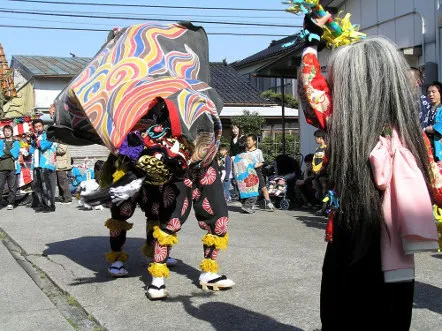
Who does what
- The head-bearer (atama-mochi) carries and moves the carved lion head.
- The body (shishi-kata) is the group under the long cloth: two people for a two-person lion, many more for a Himi-style “centipede” lion.
- The lion-teasers (shishi-ayashi) provoke and fight the lion. Often they are masked tengu; in some styles they are children — with poles and halberds in the Tonami style, or wearing flowered hats in the Imizu style.
- The musicians (hayashi-kata) play the flutes and drums.
- The clowns, such as Gannenbo or Hyottoko, keep the crowd laughing.
So many lions
In 2005, Toyama Prefecture’s board of education surveyed the region’s lion dances and published a guide to a hundred of them. In the Takaoka area alone, more than 130 lion dances were still being performed; in Oyabe, nearly 80. The styles change from valley to valley: Himi, Gokayama, Tonami, Fukumitsu, Imizu, Kinzo, Shimoniikawa, Echigo-style kagura lions and processional lions.
Watching as a guest
The dates are local. Most dances belong to spring or autumn shrine festivals, and each village keeps its own day, so ask the city or town tourist association before you go. When the lion comes to a house, stand back from the doorway: the dance is for that household. If someone waves you closer, that is a kindness — thank them. In Himi, a museum devoted to the lion dance introduces the region’s styles all year round.
Reference: Toyama no Shishimai Hyakusen (Toyama’s 100 Lion Dances), Toyama Prefectural Board of Education, 2006 (PDF, Japanese)
Published


