

One walk down Yokamachi Street tells you that Inami is a carving town. But the carving here has always lived inside the life of a temple, a festival and a community. Follow the local calendar and another side of the town appears.
July: Taishiden-e
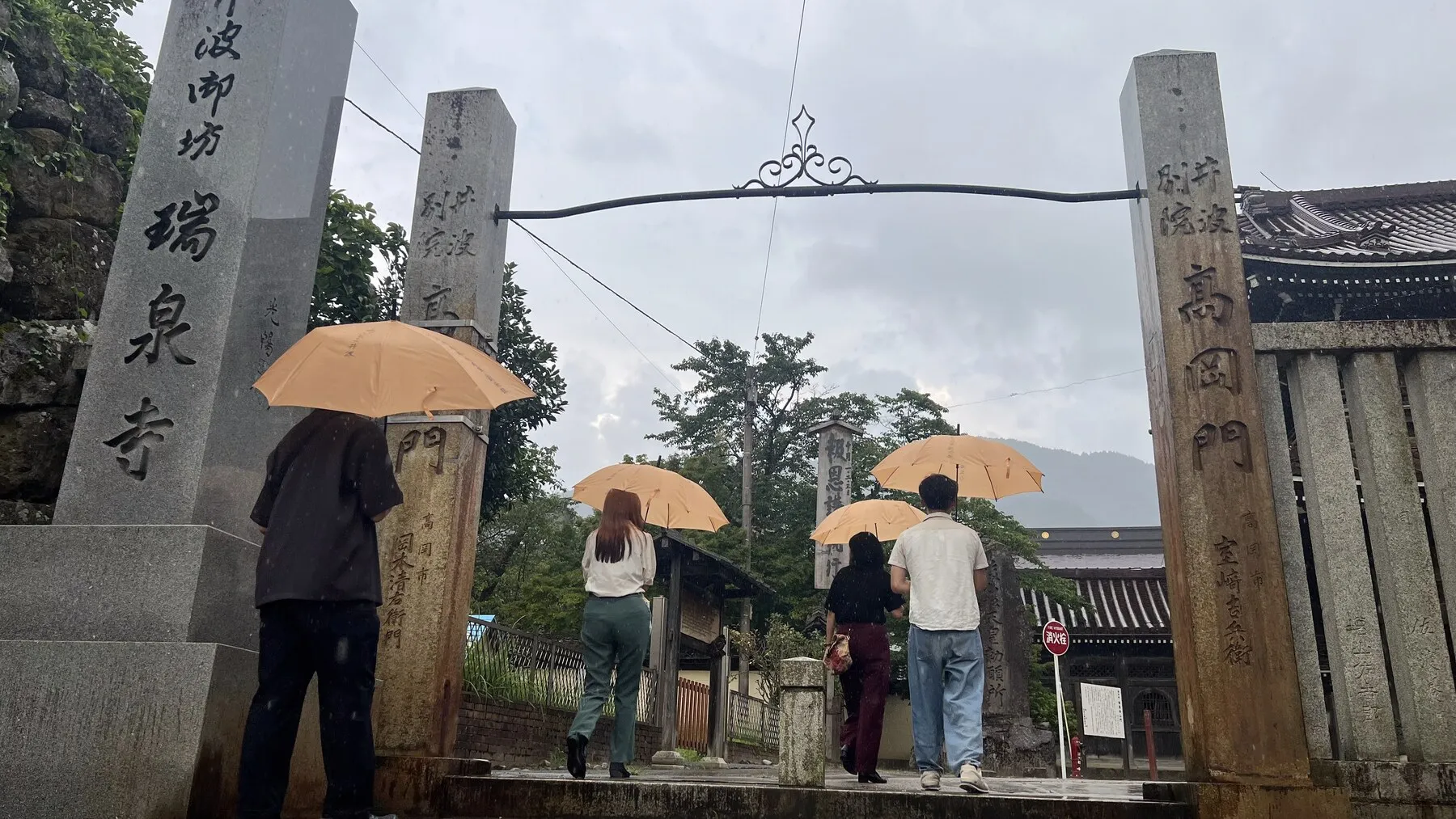
Zuisenji’s busiest days come each year from 21 to 29 July, during Taishiden-e. Said to date from around 1710, it is held in the temple’s Taishi Hall, where eight hanging scrolls illustrating the life of Prince Shotoku are “read” aloud in etoki — a storyteller points to each scene and narrates, in the old way.
During these days, the doors are opened on a statue said to show Prince Shotoku at the age of two, and you may be able to climb to the normally closed upper floor of the temple gate to see its ceiling paintings of celestial maidens. The event doubles as the annual airing of the temple’s treasures, and it is Inami’s summer ritual. Together with Shakunyo-ki in April and Ho-onko in November, it is counted among the temple’s three great observances.
May: the Yoiyasa festival
Spring brings the grand festival of Inami Hachiman Shrine, known as Yoiyasa. The eve is held on 2 May and the main day on 3 May. Six portable shrines, large and small, are carried through town to the young men’s cry of “Yoiyasa!” The shrines bring together the skills of local craftsmen — a festival worthy of a carving town. The highlight comes late on the main day, when the shrines return to the Hachiman shrine.
Sleeping in a craftsman’s town
The travel guide mentions an inn where guests can learn carving from a craftsman. It is Bed and Craft, a “dispersed” hotel: empty houses and old townhouses converted into private rentals and scattered through the streets.
Opened in 2016, each house is connected with a different craftsman or artist, and “apprentice” workshops take guests into their studios to watch and try the work. The crafts and furniture in the rooms are there to be used, and you can buy the pieces you love. You eat at restaurants in town: the whole town is the hotel. In 2026, Bed and Craft received the Circular Business award at Forbes JAPAN’s “Destinations of the Year 2026”.
Visiting a workshop
Many carvers will let you watch without stopping their work. If you would like to ask something, wait until their hands pause. Prices vary enormously with the wood and the hours involved; if a piece catches your eye, ask which wood it is and how long it took. Behind a single carving, you may hear about years of seasoning the timber before the first cut.
Published


